![]() |
| Guylan |
Craftsmanship in a Garage
Sunday, November 13, 2011
Guylan's Toddler Stool
I built another toddler stool for the grandson of our close Nashville friends, Jackie and Scott. He seems pretty happy with his new piece of furniture.
Tuesday, November 8, 2011
Wedding Keepsake Boxes
Our daughter in law, Amy asked if I could build a box that would be placed by the guest book to collect cards at the wedding in San Francisco this past September. I chose cherry wood because of it's rich warm look. In time, it develops a beautiful patina that can't be duplicated.
Three weeks later, the daughter of close family friends, Sarah Cantlon, was married in St Louis. It seemed appropriate to build a similar box to take as a wedding gift.
Both brides are very appreciative and feel it's a wonderful way to store and
cherish wedding keepsakes.
Both brides are very appreciative and feel it's a wonderful way to store and
cherish wedding keepsakes.
Saturday, July 16, 2011
Box Making
![]() |
| Wood Carving Tool Box |
![]() |
| Knick-Knack Box |
This spring, I built a couple of boxes using box joinery and jig from my November 22 post. The tool box was built for my collection of wood carving tools. The knick-knack box was built for fun out of scraps from the toddler stool project built this winter.
I selected some pieces of red oak lumber for the tool box. The first step was to cut and surface the boards to size. The next step was to cut the pins and slots to assemble the sides and ends. The table saw and box joint jig were used for this operation.
![]() |
| Red Oak Cut To Size |
![]() |
| Box Top & Bottom Parts Prepared for Edge Gluing |
Often it is necessary to cross-cut a wide panel to length and square. The panel is too wide for the power miter saw. It's too narrow to be safely supported with the table saw fence and too large to be safely supported with the table saw miter gauge. A cross-cut sled is commonly used to safely support the panel while cutting exact 90 degree cross-cuts. There are numerous variations of sleds that can be used. The homemade one I use is basic and functional. The panel is supported on the sled with a fence 90 degrees square to the blade. The rail on the underside guides the sled while keeping the 90 degree cross-cut. Mine is 20 plus years old and still delivers accurate square cuts safely.
![]() |
| Table Saw Cross-Cut Sled |
Prior to gluing I always make a "dry fit" to check that all the joints are cut correctly. Also, I check that everything fits properly and the box is square. After I applied the glue, the box was clamped and allowed to dry. Masking tape was applied to the inside ends of each part so that any glue that was squeezed out could be easily removed.
![]() |
| Tool Box Glued & Clamped |
The top and bottom were glued and clamped to the box. The pieces were cut slightly over sized so they could easily be trimmed with the router for a flush exact fit with the box sides and ends.
![]() |
| Top & Bottom Glued and Clamped to the Box |
![]() |
| Bottom Edges Trimmed with a Flush Trim Router Bit |
After the lid was cut off using the table saw and some final sanding, the finish was applied. I applied a coat of Watco walnut danish oil and three coats of gel polyurethane finish. As I have mentioned in previous blogs, It's a very quick, easy and professional looking finish procedure. All that was left was to attach the hardware and organize my carving tools.
![]() |
| Wood Carving Tool Box and "Boot" carving Project |
Sunday, May 8, 2011
Duniway School Portland, Oregon

I recently visited Portland, Oregon and thought it would be fun to visit a neighborhood where my family lived at one time. Duniway is where I attended 7th and 8th grade 52 years ago. I took my first shop class there and can still vividly remember the experience. We did some drafting, woodwork, and metalwork. The school no longer has a 7th and 8th grade, so the shop has been closed and is currently the band room. Otherwise, the school has changed very little.
Tuesday, April 5, 2011
Toddler Stools
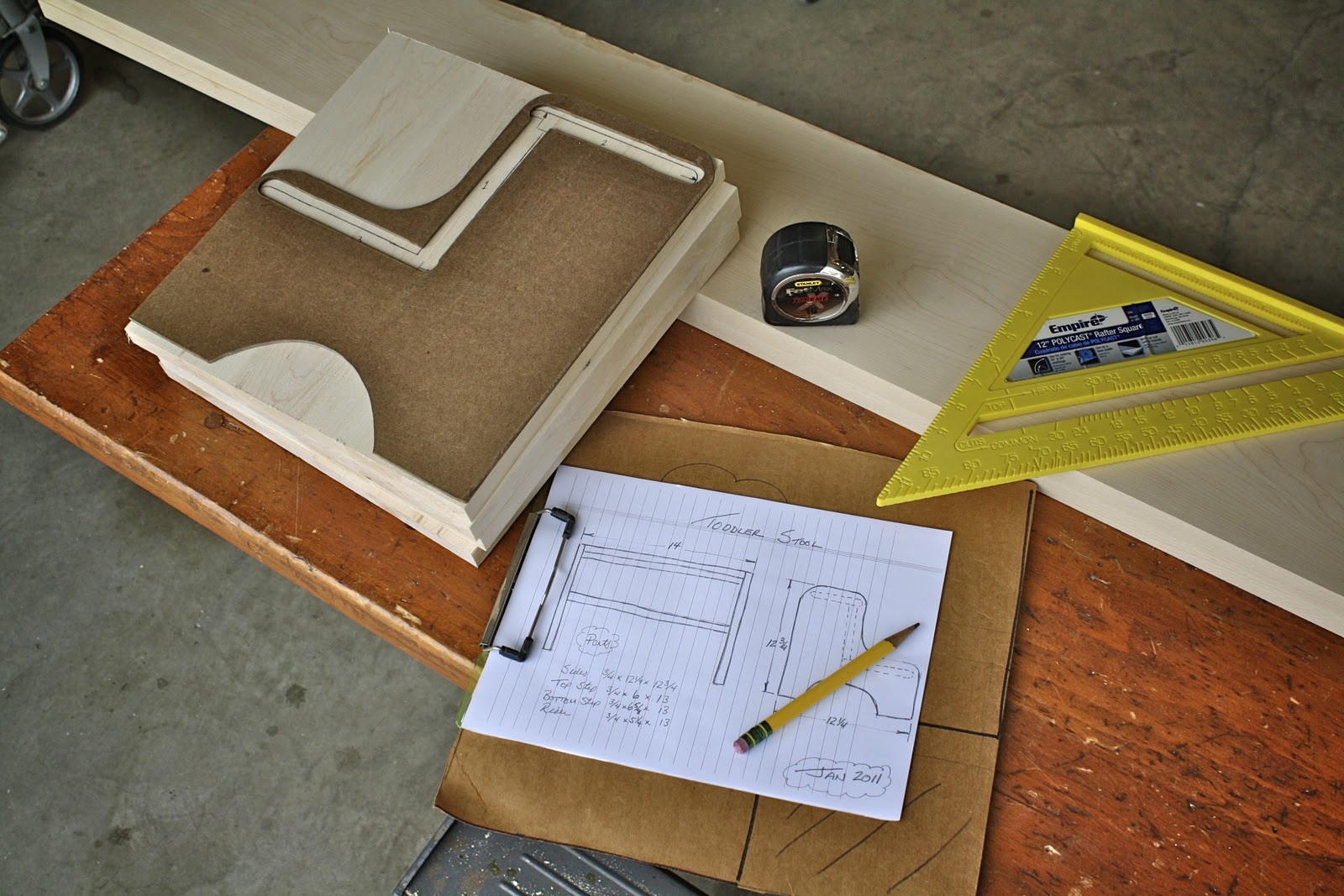
I recently built these toddler stools as a gift. Rich, a friend of our son Thad, and his wife, Joy recently had twin boys. Toddler stools make a neat and useful gift for kids especially when personalized with their names. The idea and pattern came from my good friend, Jay. The material is FAS 4/4 maple. I enjoy working with maple because it machines nicely, has minimal waste and leaves a nice smooth surface when finished. The photos can be enlarged by clicking on them.
I began by gluing up boards for making the sides. My portable planer isn't wide enough to handle planing and smoothing the wide surfaces. So, I took them to the Clovis Woodshed where they have a wide belt sander that can handle the glued up boards.
![]() |
| Material for the Four Sides, Steps, and Risers |
Once the sides were glued, surfaced, and cut to width and length, the next step was to cut dado joints to accept the step and riser. The dado is a common joint used to join pieces for strength and alignment. I like to use the router, set up with a straight bit set to a depth of 1/4". Some folks will cut dados 3/8" deep, but I have found 1/4" works as well with less wear and tear on the bit. The width of the dado cut is determined by the thickness of the piece that fits into it. Since the steps and risers are 3/4" thick, I use a 3/4" bit that is .015 oversize. This allows for a snug fit without squeezing the glue out of the joint.
![]() |
| Plunge Router with Straight bit and Support Guide for Cutting Dado Joints |
I occasionally make mistakes... Notice the photo below. Somehow the router came away from the guide and look what happened. Luckily, I had some extra material and was able to fashion another side piece.
![]() |
| Oops! |
Next, the curved edges were freehand cut on the band saw. A little material was left to be trimmed later with a router setup.
![]() |
| Cutting Curves with the Band Saw |
Band saw cuts are irregular and not smooth. One method of smoothing out the edges is to use a rasp or file. Another method is attach the pattern to the work piece with double sided tape and trim the excess material. A flush trim router bit is used in a router that is attached to the router table. The guide bearing at the top of the bit rides along the edge of the pattern while trimming the excess material. This leaves a clean smooth edge.
![]() |
| Rounding Over the Side Edges |
The names and my signature were laser etched at the yard where I purchase lumber for projects. It's an interesting process that is controlled by a computer and a laser that burns and etches whatever font or size is programed into the computer. Once the process has started, it is completly automated.
![]() |
| Laser Etching |
After Sanding all the parts, the next step was assembly. I began by "dry fitting" to be sure all the parts fit. It didn't take very long to realize that gluing, assembling, and clamping five parts at the same time was going to be difficult. After clamping, I added screws for extra strength. The screws were counterbored and wooden plugs glued to hide the screw heads.
The last thing to do was some touch up sanding and finish. With the maple, I wanted a clear satin finish. My friend Jason, at the Clovis Woodshed, recommended using a gel polyurethane. I've heard of these finishes, but never have used one. This finish has the consistency and look of apple jelly. It is the greatest! You simply rub it on with a rag and wipe off the excess with another rag. It's quick, easy, with no runs and drips. I applied three coats and ended up with a nice smooth satin finish.
![]() |
| It Doesn't Get any Easier than this Stuff |
The stools turned out great and Rich and Joy loved them. That's Lucy, our doxie checking the quality of my work. By the way, I have to give my wife Susan credit for the hand hold underneath the top step. She felt moms needed a convenient handle for moving and lifting the stools.
Sunday, January 30, 2011
Table for Bose SoundDock
Thad and his fiance, Amy, gave us a Bose SoundDock for Christmas. It's a great gift and my collection of Beatle music has never sounded better. Thad suggested that the SoundDock would be better in an open room rather than in our entertainment center, so I needed to build a small table.
I chose the clean simple design of Shaker furniture. Shaker furniture became popular in the mid nineteenth century. The Shakers and Quakers designed furniture that represented their life style. It is functional, proportional, and uses joinery such as the mortise and tenon joint without screws and nails. Danish Contemporary furniture design has similar characteristics. I made some measurements, a sketch, and headed to the garage. Luckily, I had some sugar pine on hand that could be used for the project.
![]() |
| Sugar Pine and Sketch |
The first step was to glue the table top together. The boards were cut into narrow widths and the growth rings at the ends were alternated. This prevents the table top from warping and cupping. The edges were planed on the jointer for a tight seamless fit. Yellow woodworker's glue and bar clamps were used to join the pieces together. The clamp pressure is the magic that causes the bond that makes the joint stronger than the wood.
![]() |
| Boards Glued up for Table Top |
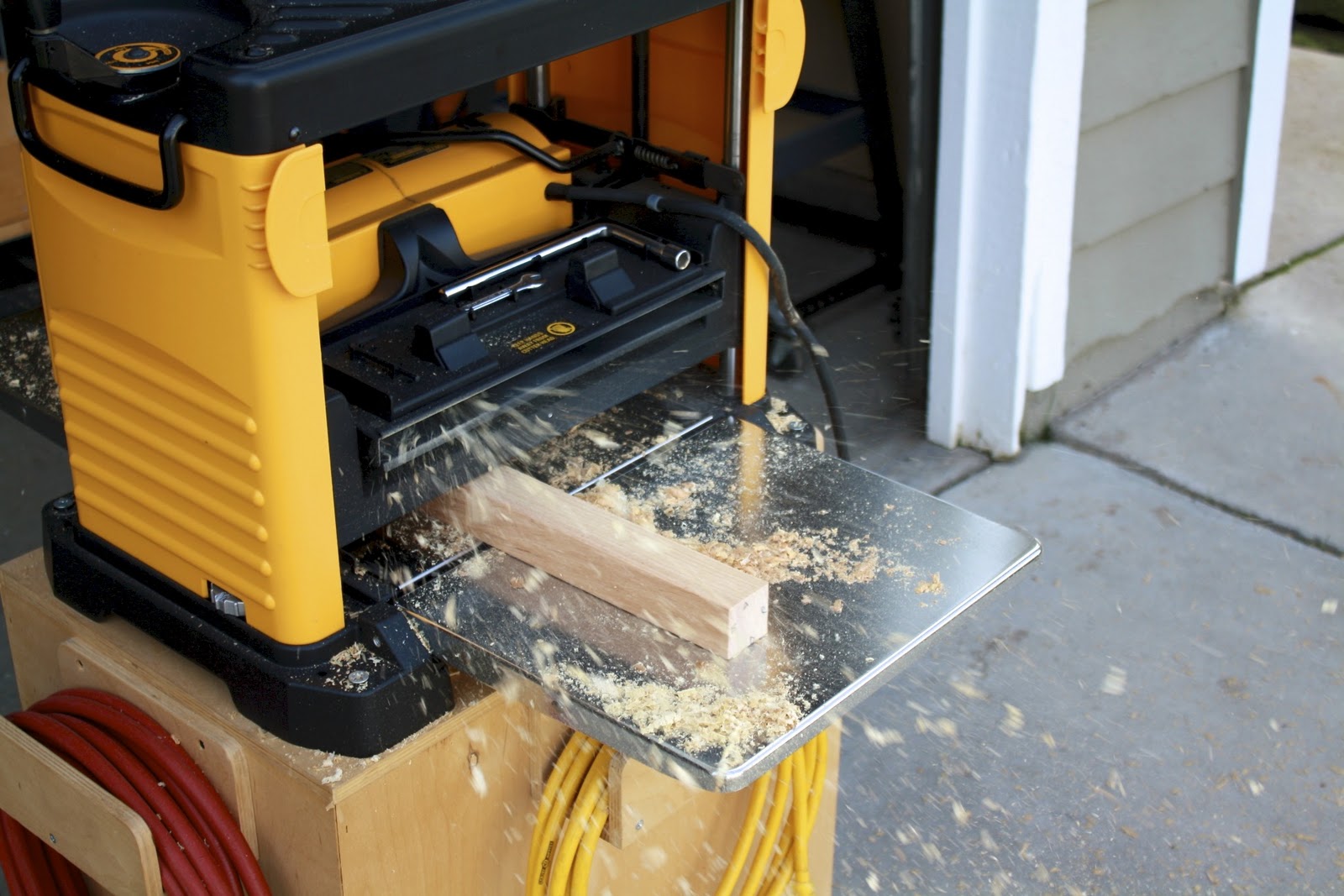
The next step was to cut the legs, aprons, and the table top to the dimensioned sizes. The table saw was used to rip the finished widths, the power miter saw was used to cut the finished lengths, and the planer smoothed the surfaces. Because the table top was too wide to cross cut with the power miter saw, a sled setup was used on the table saw.
![]() |
| The Legs Planed Square |
After all the parts were cut to size, it was time to make the mortise and tenon joint. This joint is commonly used to join the table leg to the table apron. The mortise is the slot in the leg. The tenon is on the ends of the apron. The joint is very strong and requires no screws or nails.
After the mortises and tenons were cut and checked for proper fit, the legs were tapered. Shaker furniture craftsmen created an optical illusion of tapered legs by just tapering the inside faces of the legs. This makes the operation easier while creating a graceful delicate table leg. I began by laying out the taper and "rough cutting" it with the bandsaw. I left about 1/16th inch of material that was planed smooth with the jointer.
![]() |
| Leg Mortises Cut Using a Straight Router Bit On the Router Table |
![]() |
| Apron Tenons Cut On The Table Saw |
![]() |
| "Rough Cutting" the taper with the Band Saw. |
The edges of all the parts were rounded over with the router and each piece was sanded with 150 grit garnet sandpaper and then 180 grit. I began the assembly with the legs and table aprons. Glue was applied to the mortise and tenon joint, assembled, checked for square, and clamped.
![]() |
| Leg and Table Apron Assembly |
Prior to attaching the top, I applied a pre stain sealer and stain to the leg assembly and table top. I thought this would be easier and provide better coverage. I made a sample board of sugar pine to test different stains I had on hand. I chose Min-Wax Early American Stain. I like the slight reddish walnut color. It highlights the grain with a rich warm tone. After the top was attached, I applied three coats of Tung Oil for the clear finish.
The final assembly step was attaching the table top to the leg assembly. There are various ways of doing this. I like to use the method shown below. Grooves were cut on the inside face of the table aprons. Small blocks were cut with a tongue that fit in the slots. The block was then fastened to the bottom of the table top. Glue was not used and the screw holes were drilled slightly larger than the screw diameter. This allows for slight natural movement of wood.
![]() |
| Fastening Table Top to Leg Assembly |
Sunday, January 2, 2011
SJFWA Christmas Toy Project
The San Joaquin Fine Woodworkers Association does an ambitious toy making project every year for disadvantaged families. The project begins in the spring and over 3,000 toys are built. From what I hear, it still doesn't fill the need. Materials and money are donated from service clubs, businesses, and individuals. In addition, fund raisers are done during the year to help raise money. The toys were delivered to various social service agencies and churches for distribution to needy families. It's a huge effort, but very rewarding because it provides youngsters with well made Christmas toys who may not have them.
I was invited to help with the project last September and I volunteered 3 to 6 hours a week. I worked primarily on the doll cradle. I cut, shaped, and assembled so many, that I dream about building them in my sleep. The cradle comes complete with a small quilt done by a local quilters group and a doll.
I really enjoyed working on the project and enjoyed meeting fellow woodworkers who joined together and used their woodworking skills for something that benefits the community.


I was invited to help with the project last September and I volunteered 3 to 6 hours a week. I worked primarily on the doll cradle. I cut, shaped, and assembled so many, that I dream about building them in my sleep. The cradle comes complete with a small quilt done by a local quilters group and a doll.
I really enjoyed working on the project and enjoyed meeting fellow woodworkers who joined together and used their woodworking skills for something that benefits the community.


Subscribe to:
Posts (Atom)